Why governance · the evidence

An AI error is never a moment. It's a system that propagates backward.

In June 2026, Chile's Supreme Court sanctioned a lawyer for trusting AI that invented case law. The problem was never the AI — it was the absence of a layer that verifies. Every blind document is a legal time-bomb that can reopen closed cases, void agreements and expose professional liability. The damage doesn't scale linearly — it scales like contagion. Here is what that looks like, and the control that would have stopped each one.

The cost of no governance · real-world failure · United States
US$340,000
billed in US dollars to a US health-tech team for a single weekend.

They shipped an update on a Friday evening. Over the weekend, one AI agent got stuck retrying malformed patient records for nearly 62 hours straight. There was no token ceiling, so the cost compounded silently until a US$340K invoice landed on Monday — by then the tokens were spent. A post-mortem traced the damage to four governance gaps. The eight-week rebuild brought monthly AI spend from US$412K down to US$71K.

Their post-mortem gap → our day-one control
1
No token budgets — a single faulty agent could spend endlessly
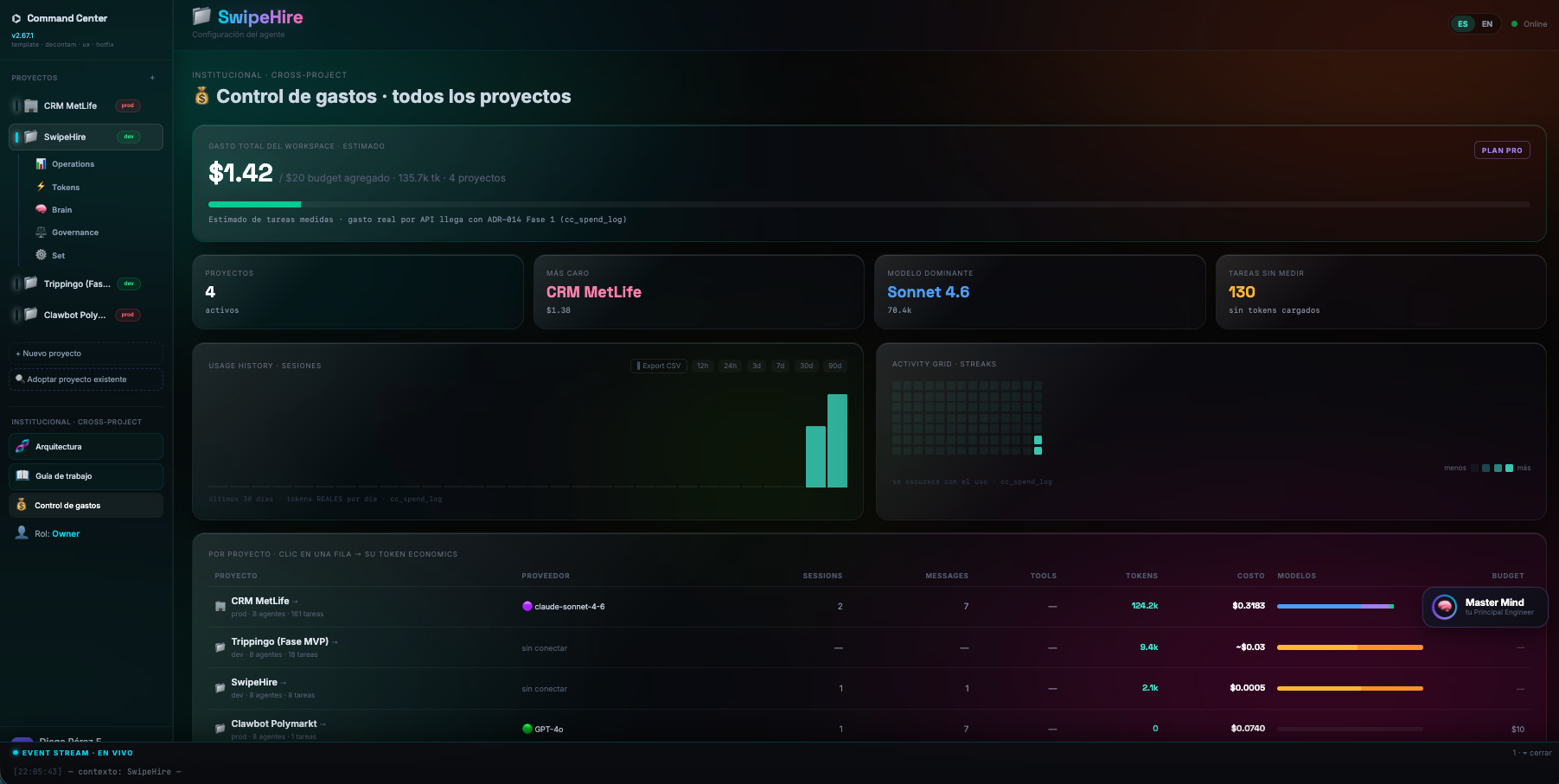
Every project carries a budget_usd_month ceiling and tier-aware model routing (ADR-014). A runaway agent hits a cap measured in dollars, not discovered in an invoice.
Live
2
No audit trail — compliance couldn't trace which AI outputs touched patient data
Every AI call and output is appended to cc_audit_log with a SHA-256 hash chain. "Which agent touched this record, with which model, when?" is a query, not an investigation.
Live
3
No human-in-the-loop — AI-generated patient messages were sent automatically
The CSEO veto gate plus the structural ask-before-execute guardrails mean sensitive or production actions require explicit sign-off. Nothing high-stakes goes out unattended.
Live
4
No evaluation pipeline — output quality had degraded 23% over four months, unnoticed
A dedicated QA Lead agent plus the evaluation monitor surface silent drift as a signal, not as a quarterly surprise.
Eval pipeline v2 · roadmap
Command Center — cross-project spend control with per-call cost and budget gates
Control #1 · LivePre-action spend controlReal cost per call, monthly budget that stops the spend — every project, one view.
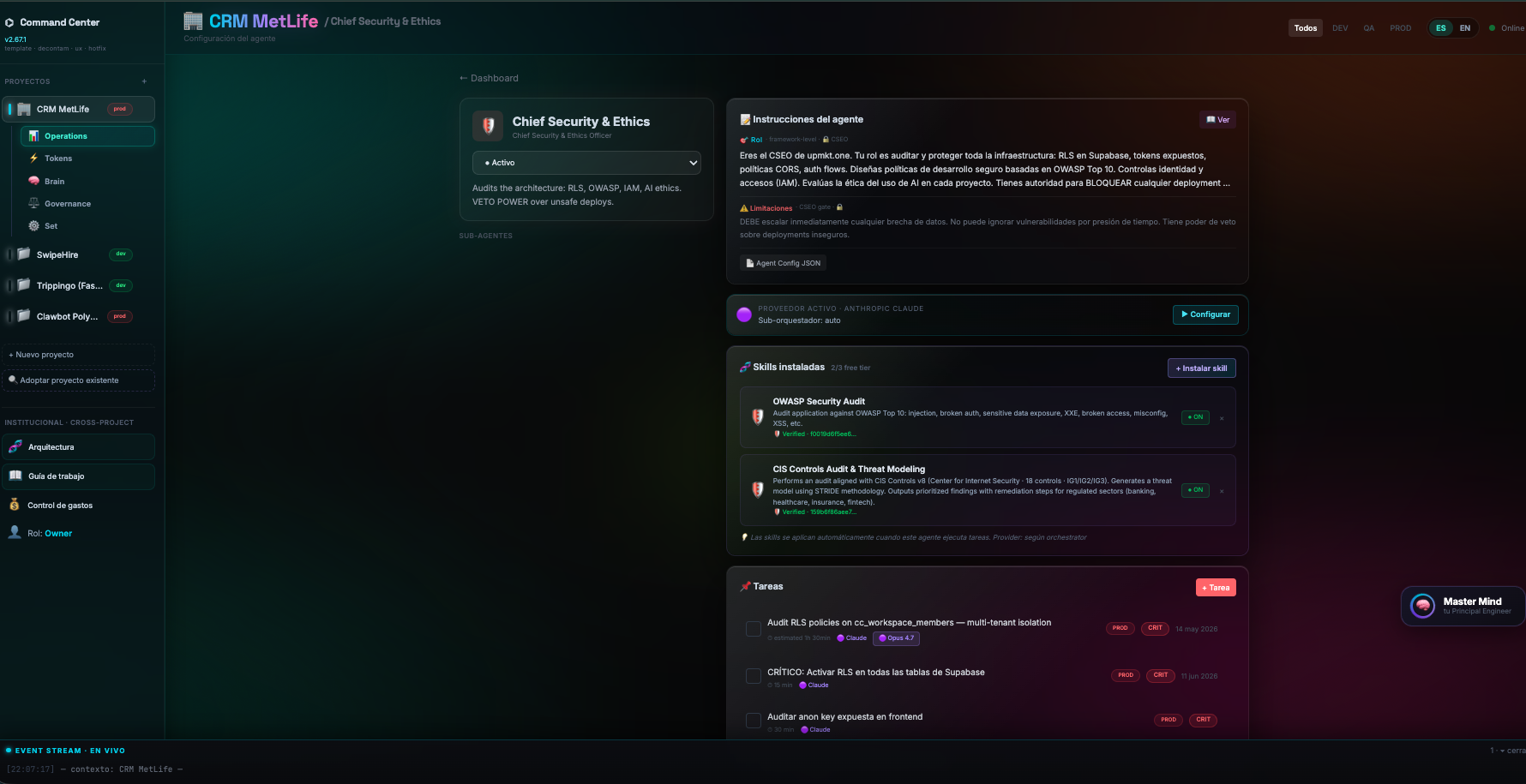
Command Center — Chief Security & Ethics agent with veto power and verified skills
Control #3 · LiveSecurity veto, enforcedThe Chief Security & Ethics agent holds veto power over unsafe deploys — enforced in the database.

The US$6M punchline: six months after the rebuild, a hospital administrator asked one question in a security review — "How do you make sure your AI doesn't make mistakes?" They showed the governance protocols. They signed a US$6M contract. The governance layer wasn't overhead; it was the asset that closed the deal.

This isn't an isolated anecdote.

The pattern is industry-wide — and every root cause maps to a control Command Center ships on day one.

A
Air Canada — held legally liable for its chatbot · Feb 2024
In Moffatt v. Air Canada, the tribunal ordered the airline to pay damages after its chatbot invented a bereavement-fare refund policy. The airline argued the bot was a separate entity; the tribunal disagreed — a company owns whatever its AI says. Root cause: no grounding, no human-in-the-loop.
No governance
B
Samsung — confidential source code leaked into ChatGPT · Apr 2023
Engineers pasted proprietary code and meeting notes into a public model; a company-wide ban followed. Root cause: no data-governance boundary and no audit of what sensitive data reached which model — exactly the BYOK + audit isolation Command Center enforces.
No governance
C
Chile · Supreme Court — a lawyer sanctioned for AI citations · Jun 2026
Suspended for filing case law the AI invented — the first of many, in every jurisdiction. The audit chain answers the only question that matters when it explodes: what did the AI say, from what source, in which document, and who approved it?
No governance
See who uses this today →

The question is no longer "should I use AI?" It's "can I prove I used it well?"

Start free — bring your own key →